Forget the Balance Sheets and Start with Trust: How Future-Ready Central Public Sector Enterprise Boards of India are Redefining Governance
By- Institute of Directors | Authored by - Amit Kumar

By- Institute of Directors | Authored by - Amit Kumar
In today's fast-paced economy, the world is moving rapidly, and India is rising. Capital moves faster, information travels instantly, social media goes viral in a jiffy. In such an environment, trust becomes one of the most valuable assets of any organisation.
And how do we develop trust?
The board of directors is the ultimate custodian of trust. They are the institution that provides strategic direction, oversight and accountability.
But the real test lies in today's environment; how we anticipate, how we listen, how we react to them, how we prevent them. Further, are we creating value for the organisation and the country in general? And, more importantly, are we able to keep pace with the changes?
So, the board has a huge responsibility to understand each and everything. Today, if you see, how will the trust be there in the investor?
Ultimately, it is built on three pillars:
1. Transparency
2. Predictability, and
3. Integrity
India's next aviation transformation is about a future of aviation in India, where aircraft are increasingly designed, manufactured, financed, leased, maintained and supported domestically.
So, investors are looking at all these things in the organisation. More than the balance sheet, they have to be more concerned about cyber security, disruptive technologies and geopolitical developments.
So, who would have thought that the closure of Strait of Hormuz would have an impact on the tile manufacturers in Morbi? Today, everybody has started to look at how to ensure that these geopolitical disruptions do not impact their businesses or their organisations or their environment.
Climate risk is there for all of us to see. Supply chain vulnerabilities are always there because today the world is inter-connected. Data protection, talent management and rebranding are also important. Today's newspaper carries front page advertisement of a renowned real estate developer which does not say we build houses but we build lives. So, the rebranding of the organisation is also a big challenge. Further, as a board, there is always a tension between short-term performance and long-term value creation. So, most of the time, you find that markets always react to the performance that they see but organisations are built over years and years of hard work by employees and the vision of leaders who, from time to time, represent those organisations.
So, it becomes very important for all of us to understand how we develop value and stay relevant with the changing times. How do we see our organisation 10 years from now?
A lot of talk is there about diversity in the boardrooms. But we need to go beyond gender diversity. More important now is diversification of knowledge, skill set and experience. We need to think and give directions for action and therefore, diversity in my opinion is very important. A board that questions, a board that asks about particular issues and also ensures that there is a direction, a focus and a vision. So, diversity lies in the thought process and that comes when you have different people coming from different geographical regions, experience, as well as areas of work.
People talk about disruptive technology and that we need to imbibe it, depending on how the organisation wants to utilise such technology. How will it impact my operational efficiency? How will it ensure that my employees do not get affected? But the more important aspect is that this technology is there to be utilised and therefore, the board of the future must not only be technologically-aware, but also must become technologically-driven in a production environment. Therefore, we need to go ahead and utilise Artificial Intelligence and use it for the efficiency of the organisation.
ESG till late was a tick in a box but things are changing now.
The proof is that today, India has greened its energy chain, with more than 50% of its energy coming from renewables. Nuclear energy is at the cusp of a major energy change in our country and therefore, as an organisation and as board of directors, we also need to ensure that it should not remain just on paper. Energy efficiency, responsible resource utilisation and how we can build employees' trust as well as their future and to take care of the communities.
I represent the central public sector. Typically, my responsibility is accountability not only to their shareholders, but also to the citizens of the country. The Central Public Sector Enterprise (CPSE) board therefore has to balance commercial efficiency with public assets. The board has to ensure that public assets are utilised efficiently, capital is allocated responsibly, and the enterprise remains financially and operationally sustainable. But that does not mean that we should lower the standards of corporate governance of our companies. And the proof lies in the fact that most of you would know that the majority of CPSEs in our country are doing wonderfully well. They are among the highest dividend payers, most professionally and efficiently managed, and are adding a lot of value to the organisations as well as the country at large.
I would like to share my experience with AI Engineering Services Limited (AIESL). It is one of the largest Maintenance, Repair and Operations (MRO) in the country and a major contributor to the aviation sector in our country.
All of us know that India is entering a defining phase in civil aviation and is moving beyond rapid growth in passengers, airports and fleet size, and building a complete, globally competitive aviation ecosystem and AIESL is playing a very important role in this transformation.
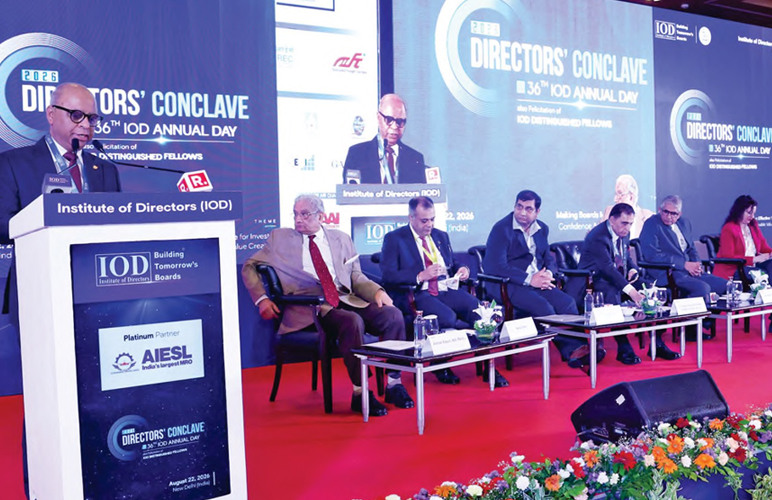
AIESL came up only after the disinvestment of Air India. So, it is a five-year-old CPSE, regularly dishing out revenues of C1,800 crores and also generating PAT around Rs.200 crores. During the last one and a half years, the AIESL board has developed a 10-year vision of making India a global MRO hub, a roadmap for assembling and manufacturing aircraft in India and to deliver this, they have redeveloped the delegation of powers.
They have given more power to the operational areas to enable faster decision-making, as well as the induction of IT. Today, all the work packages and invoices and revenue management, as well as all the operations, have become technology and system-driven.
I conclude with what India's next aviation transformation is about a future of aviation in India, where aircraft are increasingly designed, manufactured, financed, leased, maintained and supported domestically. Where Indian aviation enterprises compete globally, and boards and companies like ours are going to combine ambition, safety, innovation, technology and accountability with trust.
So, I started with trust and would like to end with trust.
Excerpts from a 'Special Address' delivered by Mr. Amit Kumar, Chairman & Managing Director, AI Asset Holding Ltd. (AIAHL), and Chairman, AI Engineering Services Ltd. (AIESL), during the Inaugural Session of the Annual Directors' Conclave 2026 & 36 IOD Annual Day, hosted on August 22, 2026 at the Hotel Le-Meridien, New Delhi (India).
Owned by: Institute of Directors, India
Disclaimer: The opinions expressed in the articles/ stories are the personal opinions of the author. IOD/ Editor is not responsible for the accuracy, completeness, suitability, or validity of any information in those articles. The information, facts or opinions expressed in the articles/ speeches do not reflect the views of IOD/ Editor and IOD/ Editor does not assume any responsibility or liability for the same.

Oct 15, 2026
Independent Directors (IDs) should complement executive colleagues who wrestle with day-to-day issues that burn up time needed for the independent thought expected of company directors. IDs and executive directors should understand each other's roles and how their respective contributions can be complementary.
Read more
Oct 15, 2026
The October 2026 issue of Director Today, themed “What Truly Gets You the Board Seat: Equipping IDs for the Future Boardrooms,” addresses a question that every aspiring and serving Independent Director (ID) must answer squarely, “What does it take to earn a seat in an Indian boardroom, and what does it take to keep it?”
Read more
Sep 24, 2026
Today when the AI and its innovative tools are fast emerging as drivers of not only operational excellence but are significantly helping in strategic decisions and in building competitive advantage, leadership roles in the entire context of corporate governance are required to be revisited and transformed.
Read more
Sep 07, 2026
AI is the biggest riser in this year's annual survey. It jumps from tenth to second place after cyber issues, highlighting the emerging risks for companies in almost all industry sectors. Confronting cyber and AI risks and threats is a strategic issue for corporate boards and an operational concern for business executives.
Read more
Sep 07, 2026
As corporates race toward the September 30 deadline, we are yet to see whether the needle has moved from frantic box-ticking to real accountability, something our new generation of emotionally conscious citizens and environment activists will also demand & perhaps approve.
Read more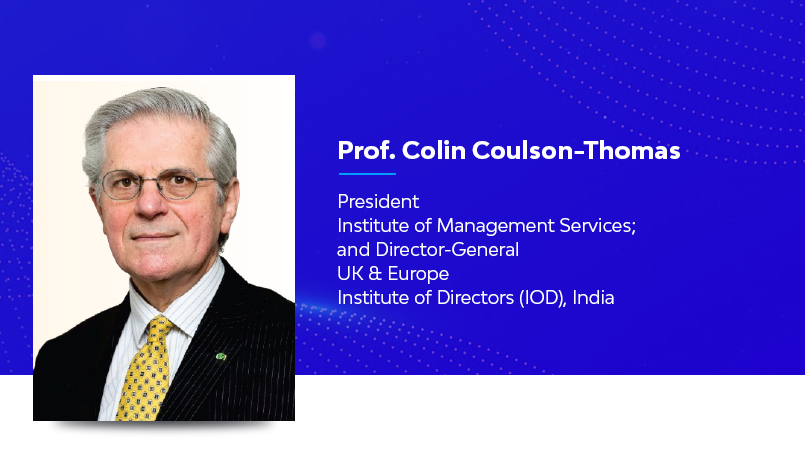
Aug 12, 2026
Human, eco-system and planetary health are inter-related. Pollution of the environment, biodiversity loss and climate change are also important drivers of the emergence and spread of disease. Life forms adapt in differing ways and at varying speeds. We can learn from species with whom we have a common ancestry.
Read more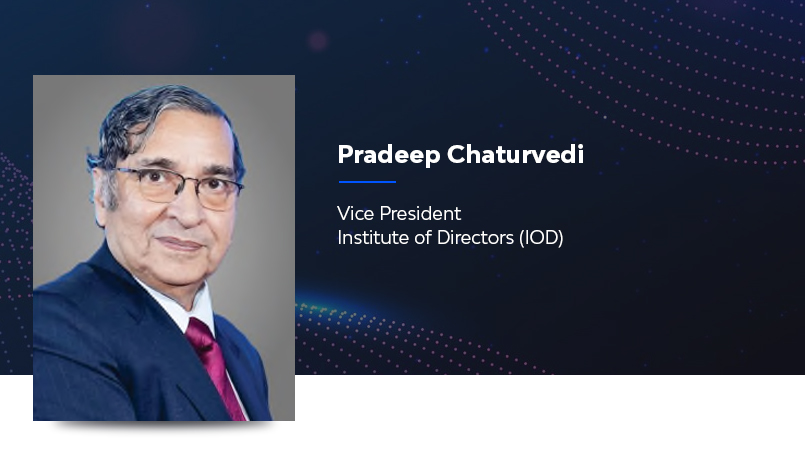
Aug 12, 2026
Climate change has emerged as one of the defining governance challenges of our time. Increasingly frequent extreme weather events, disruptions to supply chains, resource scarcity, and evolving stakeholder expectations are reshaping the global business landscape.
Read more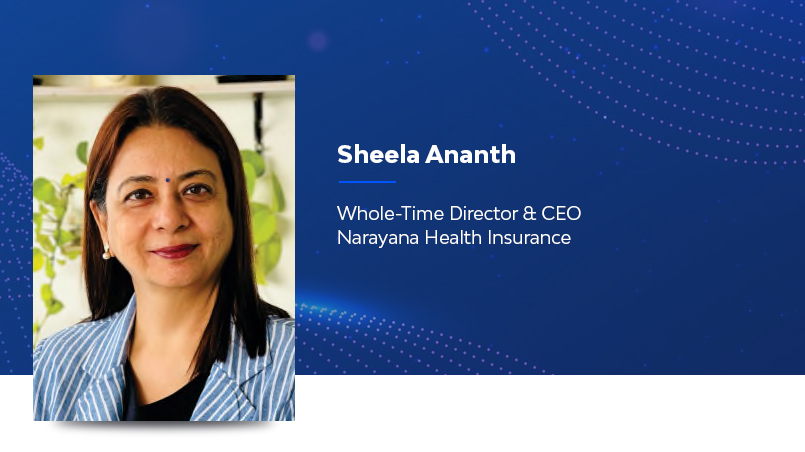
Jul 07, 2026
Health insurance literacy in India is facing a significant challenge. It is not merely a rural issue. It is an urban issue, a professional issue, and perhaps most importantly, a women's issue. Until we recognise the problem clearly, we risk designing solutions for the wrong diagnosis.
Read more
Jul 07, 2026
What I found when I arrived was this: there was a very simplified Board framework at SBIML with only one Committee viz ECOD (Executive Committee of Directors). No Audit Committee. No Nomination and Remuneration Committee. No Risk Management Committee.
Read more
Jun 12, 2026
Investigations of insolvencies can reveal deficiencies in the attention given to basics such as monitoring cash flows and critical trends or anticipating pressure points on the ability to meet financial commitments as they fall due.
Read more
Oct 31, 2025
Aug 08, 2025

Aug 08, 2025
Aug 08, 2025

Aug 08, 2025

Aug 08, 2025
Aug 08, 2025
Jul 18, 2025

Feb 06, 2025

Nov 09, 2024

Jun 01, 2024

Mar 05, 2024